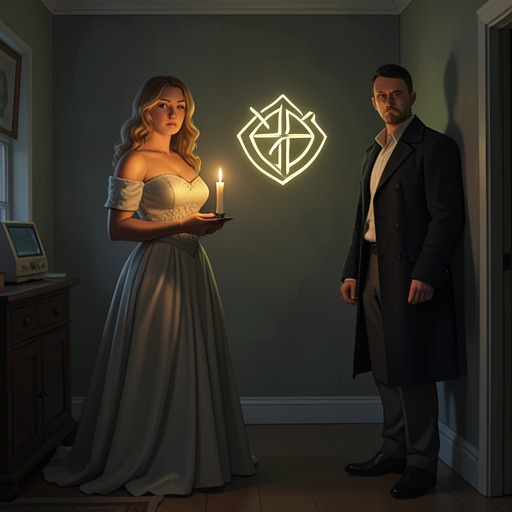
Solar Eclipse and Meteor Shower Trigger the Prophecy Crisis
A Werewolf Thing: A Rejected Mate Werewolf RomanceSolar Eclipse and Meteor Shower Trigger the Prophecy Crisis is the turning point at which a seemingly remote prophecy becomes an imminent threat to the supernatural world and to Saphira's family. The predicted celestial signs—an eclipse that makes the sun appear black and a meteor shower crossing the sky—connect the fate of vampires, werewolves, Saphira, and Trevor. Once the signs occur on the day Trevor and Saphira's father dies, the prophecy is no longer theoretical: it becomes a framework through which the twins interpret death, war, pregnancy, and their obligation to an entire species.
Prophecy and Celestial Signs
The crisis begins when Amanda tells Saphira that a war between vampires and werewolves is destined to occur on the night when the sun is black and stars cross the sky. The conflict is not merely a battle between rival supernatural races; it is supposed to determine which race will become dominant. Amanda further reveals that two hybrids of the same origin will lead the winning side, a description that immediately raises the possibility that Saphira and Trevor are the figures named by the prophecy.
Amanda initially explains that the eclipse and meteor shower are expected naturally only in another thousand years. That apparent distance gives the prophecy the quality of an ancient, almost irrelevant warning. The danger changes when she adds that a solar eclipse will occur in March and that the councils are discussing the possibility that a powerful sorcerer will deliberately create a meteor shower on the same night. Natural or manufactured, the signs would be enough to provoke violence: the vampire and werewolf councils would not care whether the celestial event was authentic if it supplied a pretext for war.
The crisis therefore depends on both destiny and interpretation. The prophecy identifies a pattern, but supernatural leaders may force events to fit it. A sorcerer's planned meteor shower could turn an astronomical coincidence into a political weapon, allowing the councils to treat the eclipse as confirmation that the appointed war has arrived. The celestial imagery functions as a public signal, while its threatened artificial creation exposes the extent to which prophecy can be activated by choice.
Pregnancy and the Question of Leadership
The prophecy becomes personal for Saphira when she confesses to Trevor that she is pregnant. She tells him that neither of them can afford serious injury because harm to him might affect her baby. Her pregnancy changes the stakes of the coming conflict: she is not considering only her own survival, and the unborn child becomes part of every calculation about combat, succession, and responsibility.
After their father's death, Trevor insists that Saphira must not fight because she is pregnant and cannot lead an army. His objection treats pregnancy as a practical and political restriction at once. Saphira rejects that limitation. Because she is half faery, she argues that she can cast a protective charm on herself, but Trevor still considers participation too dangerous. Their disagreement is not simply about tactics. It is a struggle over whether Saphira's pregnant body determines her public role, or whether she retains the authority to decide what her possible status as a chosen hybrid requires.
Saphira ultimately declares that if she and Trevor are the chosen ones, she will fight whether Trevor approves or not. Her determination links maternal protection with military agency rather than accepting them as mutually exclusive. The pregnancy makes the decision more dangerous, but it does not erase her sense of responsibility. Instead, it intensifies the conflict between preserving a future child and defending the supernatural race whose future the prophecy places in their hands.
The Eclipse, Death, and Recognition
The predicted day arrives with the eclipse and meteor shower expected to be created. Saphira knows that the day is supposed to bring something terrible to the twin hybrids in Amanda's prophecy, and she hopes that ordinary domestic routine can survive the ominous date. Her morning with Trevor begins quietly, with food and mutual questions about whether each is all right, yet both understand that the questions conceal fear of the prophecy.
The private calm breaks when Trevor runs into the kitchen in tears. Saphira recognizes the catastrophe before he speaks: pain overwhelms her, her knees buckle, and Ashton catches her as the oxygen seems to leave her lungs. Trevor then tells her that their father is dead. The death gives the celestial event an immediate human cost and becomes the first concrete confirmation that the day has brought the terrible consequence Amanda predicted.
The scene operates as both reversal and recognition. Before Trevor enters, Saphira and Ashton briefly occupy a space of affection and apparent normality; afterward, death has entered the family and the prophecy has acquired evidentiary force. Saphira's bodily collapse also echoes the story's larger movement from abstract prediction to embodied catastrophe. The eclipse is not presented as distant symbolism alone. It is tied to a death announcement, a family rupture, and the realization that the twins may stand at the center of an approaching war.
The Twins Accept the Coming War
Later, while traveling with Trevor, Saphira asks whether Amanda was right about everything. She specifically connects the prophecy's warning about the hybrids, the eclipse, the meteor shower, and the day their father died. Trevor confirms that the eclipse and meteor shower occurred while Saphira was unconscious. This confirmation converts suspicion into shared recognition: the sequence of events described by Amanda has come to pass.
Saphira then asks whether she and Trevor are the hybrids in the prophecy. Trevor does not dismiss the possibility. Instead, he says that if Amanda was right and they are the prophesied figures, they will fight. His response turns supernatural identity into a duty. The twins are no longer merely asking what they are; they are deciding what they must do if the prophecy has selected them.
Their conversation ends in cooperation rather than certainty. Trevor apologizes for trying to stop Saphira and admits that he is fairly sure they are the hybrids Amanda meant. He says that war may begin at any moment and that they will be responsible for an entire species, asking for his sister's help. Saphira accepts by nodding, and the declaration that war is coming soon closes the crisis's immediate arc. The celestial signs have produced no completed battle in these scenes, but they have established the battlefield, identified its presumed leaders, and compelled the twins to act as a unit.
Narrative Significance
The event joins public catastrophe to private inheritance. The prophecy concerns the dominance of vampires or werewolves, yet its pressure is experienced through pregnancy, sibling loyalty, bereavement, and the possibility that Saphira's child will inherit the consequences of a war begun before birth. Saphira's later life with her six-year-old daughter Crystal gives the prophecy an implicit counter-image: after omens, death, and threatened warfare, domestic continuity remains possible, even though the supplied scenes do not explain how the conflict is resolved.
Structurally, the eclipse and meteor shower mark a passage from discovery to obligation. Amanda's revelation supplies the hidden pattern; the celestial signs and their coincidence with the father's death provide recognition; Trevor and Saphira's decision to fight supplies commitment. The episode's central tension is therefore not whether the prophecy sounds extraordinary, but whether the twins will permit an inherited prediction to govern their identities and choices. Their answer is neither passive surrender nor rejection. They accept the possibility that they are chosen, argue over the cost, and move toward the coming war together.